
Sleep Apnea as a Secondary: Why the Direct Path Usually Fails and What Actually Works
The Big Picture
Sleep apnea is one of the most claimed conditions in the VA system and one of the most
misunderstood.
Three beliefs drive most of the wasted effort:
1. “I’ll prove service caused it.” If obstructive sleep apnea was never diagnosed
during active duty, a direct service connection theory is fighting uphill for structural
reasons — not because the veteran is wrong.
2. “It’s a burn pit presumptive.” It is not. Sleep apnea appears nowhere on VA’s
presumptive lists.
3. “TERA covers it.” A toxic exposure risk activity finding establishes exposure, not
causation. It is not an automatic win for sleep apnea or anything else.
What does work, repeatedly, is the same structure that works for headaches: a
secondary theory built on an already service-connected condition, supported by
a credible medical opinion that engages the mechanism.
This breakdown covers why the direct path breaks down, which secondary theories
carry weight, the obesity-as-intermediate-step doctrine that governs most of them, and
how DC 6847 actually reads on the CPAP question.
Why Direct Service Connection Usually Fails Here
Direct service connection requires a current diagnosis, an in-service event or injury, and
a nexus linking them. For sleep apnea the third element collapses under a specific
problem: OSA is a diagnosis of exclusion made by sleep study. Without a sleep
study, there is no diagnosis — and sleep studies were rarely ordered during most
veterans’ service.
So the record typically contains no in-service diagnosis, which means an examiner is
asked to opine backward across years or decades with nothing to anchor to.
One honest qualification, because absolutes here are wrong. A direct theory is
harder, not categorically impossible. Where service treatment records document the
symptom picture — witnessed apneas, chronic loud snoring, persistent daytime
somnolence, morning headaches, fatigue that was worked up and not otherwise
explained — and lay evidence from people who served alongside the veteran
corroborates it, there is something for a clinician to work with. Lay evidence is
competent as to observable symptoms.
The realistic read: a direct theory needs documented in-service symptoms. With
nothing in the record but a post-service diagnosis and a claim that service caused it, the
direct path is where sleep apnea claims tend to stall.
What Sleep Apnea Is Not
Not a PACT Act presumptive. VA’s presumptive conditions for burn pits and fine
particulate matter include asthma, chronic sinusitis, chronic rhinitis, COPD, chronic
bronchitis, constrictive or obliterative bronchiolitis, emphysema, granulomatous
disease, interstitial lung disease, pleuritis, pulmonary fibrosis, sarcoidosis, and a range
of cancers. Sleep apnea is not among them.
Not a TERA outcome. A TERA determination establishes that a veteran participated in a
toxic exposure risk activity. It supplies no medical link. Under 38 U.S.C. § 1168 it can
trigger an examination and nexus opinion — and that opinion still has to come back
favorable on the medicine.
But here is the constructive turn: several of those burn pit presumptives — asthma,
chronic sinusitis, chronic rhinitis — are conditions that, once service-connected, can
serve as the primary in a sleep apnea secondary theory. The presumption does the work
of establishing the primary. The secondary theory does the rest. That is a real pathway,
and it is frequently overlooked by veterans who conclude “sleep apnea isn’t
presumptive” and stop there.
The Two Secondary Theories
Secondary service connection under 38 CFR § 3.310 operates on two theories:
Causation — § 3.310(a). A disability proximately due to or the result of a service-connected disease or injury shall be service connected.
Aggravation — § 3.310(b). Any increase in severity of a nonservice-connected
condition proximately due to a service-connected condition, and not due to natural
progress, will be service connected. Caution: this requires a documented baseline
level of severity established by medical evidence created before the onset of
aggravation, or the earliest evidence available thereafter. No baseline, structural
problem.
Under either theory, the advantage over the direct path is the same one that makes
headache secondaries work: the primary condition’s service connection is already
decided, and the medical question is about two conditions that exist right now and can
both be examined today.
Direct Mechanism Theories
Where a service-connected condition affects breathing, airway, or sleep architecture
directly, the theory does not need to route through weight at all. These are the cleanest
arguments available:
Chronic sinusitis, allergic rhinitis, and nasal obstruction. Upper airway
inflammation and nasal obstruction increase airway resistance and are recognized
contributors to sleep-disordered breathing. Where rated and currently symptomatic,
this is a direct anatomical mechanism.
Asthma and chronic bronchitis. Recognized associations exist between obstructive
airway disease and sleep-disordered breathing. (See the rating caution below — this
pairing has a specific complication.)
Mental health conditions. Two distinct pathways: medication effects (many
psychotropic medications are associated with weight gain) and disrupted sleep
architecture. The medication pathway is often the more concrete of the two.
Chronic pain and musculoskeletal conditions. Sleep fragmentation from pain,
sedating pain medications, and reduced activity all connect to sleep-disordered
breathing through recognized mechanisms.
Diabetes and neuropathies. Bidirectional associations between type 2 diabetes and
OSA are documented in clinical literature, though the direction of causation requires
careful handling in any opinion.
The Obesity Intermediate Step — Get This One Right
This is the theory most sleep apnea secondaries actually run on, and it is governed by a
specific precedential authority with a three-part test that most veterans have never
seen.
VAOPGCPREC 1-2017 (VA Office of General Counsel, January 6, 2017) holds that
obesity is not a disease or injury for purposes of 38 U.S.C. §§ 1110 and 1131, and is
not a “disability” for purposes of secondary service connection under § 3.310. Obesity
cannot be service connected on its own, directly or secondarily, and receives no rating.
However — and this is the operative part — obesity may act as an “intermediate step”
between a service-connected disability and a claimed condition, permitting secondary
service connection of that claimed condition under § 3.310(a).
Applied to sleep apnea, the General Counsel’s framework requires resolution of three
questions:
1. Did the service-connected disability cause the veteran to become obese?
2. Was that obesity a substantial factor in causing the sleep apnea?
3. Would the sleep apnea not have occurred but for the obesity caused by the
service-connected disability?
All three. That third element is a but-for requirement, and it is where these theories
most often fail — a veteran with multiple independent risk factors for OSA has a harder
time establishing that the condition would not have occurred but for service-connected-
disability-driven weight gain.
In Walsh v. Wilkie, 32 Vet. App. 300 (2020), the Court of Appeals for Veterans
Claims held that the Board must consider the obesity-intermediate-step theory
predicated on aggravation where appropriate — extending the framework beyond
causation alone.
Where this fits sleep apnea claims:
Orthopedic and musculoskeletal conditions that reduced mobility and activity,
contributing to weight gain
Depressive and anxiety disorders, including medication-associated weight gain
Any rated condition whose functional impact plausibly drove the weight trajectory
A word on framing. This pathway is often described as easy. It isn’t. It is the most
viable route, which is a different claim. A three-part test with a but-for element is a realevidentiary burden, and a medical opinion that asserts “obesity from his back condition
caused his sleep apnea” without walking each element is an opinion that fails the test on
its face. The veterans who succeed here are the ones whose opinion addresses all three
questions explicitly.
What supports it in the record: a documented weight trajectory. Entrance and
separation physicals, weight at separation, weight in the years following, and treatment
notes across the period when the service-connected condition worsened. A weight
timeline that tracks against the progression of the primary condition is what makes
element one arguable.
An Important Rating Caution on Respiratory Primaries
This is a technical point that rarely appears in veteran-facing content, and it can
materially change the value of a claim.
Under 38 CFR § 4.96(a), ratings under diagnostic codes 6600 through 6817 and
6822 through 6847 will not be combined with each other. A single rating is
assigned under the diagnostic code reflecting the predominant disability, with
elevation to the next higher evaluation where overall severity warrants it.
Sleep apnea is DC 6847. Asthma is DC 6602. Chronic bronchitis is DC 6600. All fall
within that non-combination range.
The practical implication: a veteran who establishes sleep apnea as secondary to
service-connected asthma may not receive two separate combined evaluations — the
regulation directs a single rating under the predominant disability. That does not make
the claim pointless (predominant-disability analysis and elevation still matter, and
service connection has downstream value), but a veteran expecting two stacked ratings
may be disappointed.
Sinusitis and rhinitis diagnostic codes sit outside that range, so the same restriction
does not apply to them in the same way.
This is exactly the kind of interaction worth reviewing with an accredited representative
against an actual rating sheet before assuming what a grant would be worth.
The CPAP Question and DC 6847
Sleep apnea is rated under Diagnostic Code 6847, Sleep Apnea Syndromes
(Obstructive, Central, Mixed), in 38 CFR § 4.97. The current criteria:
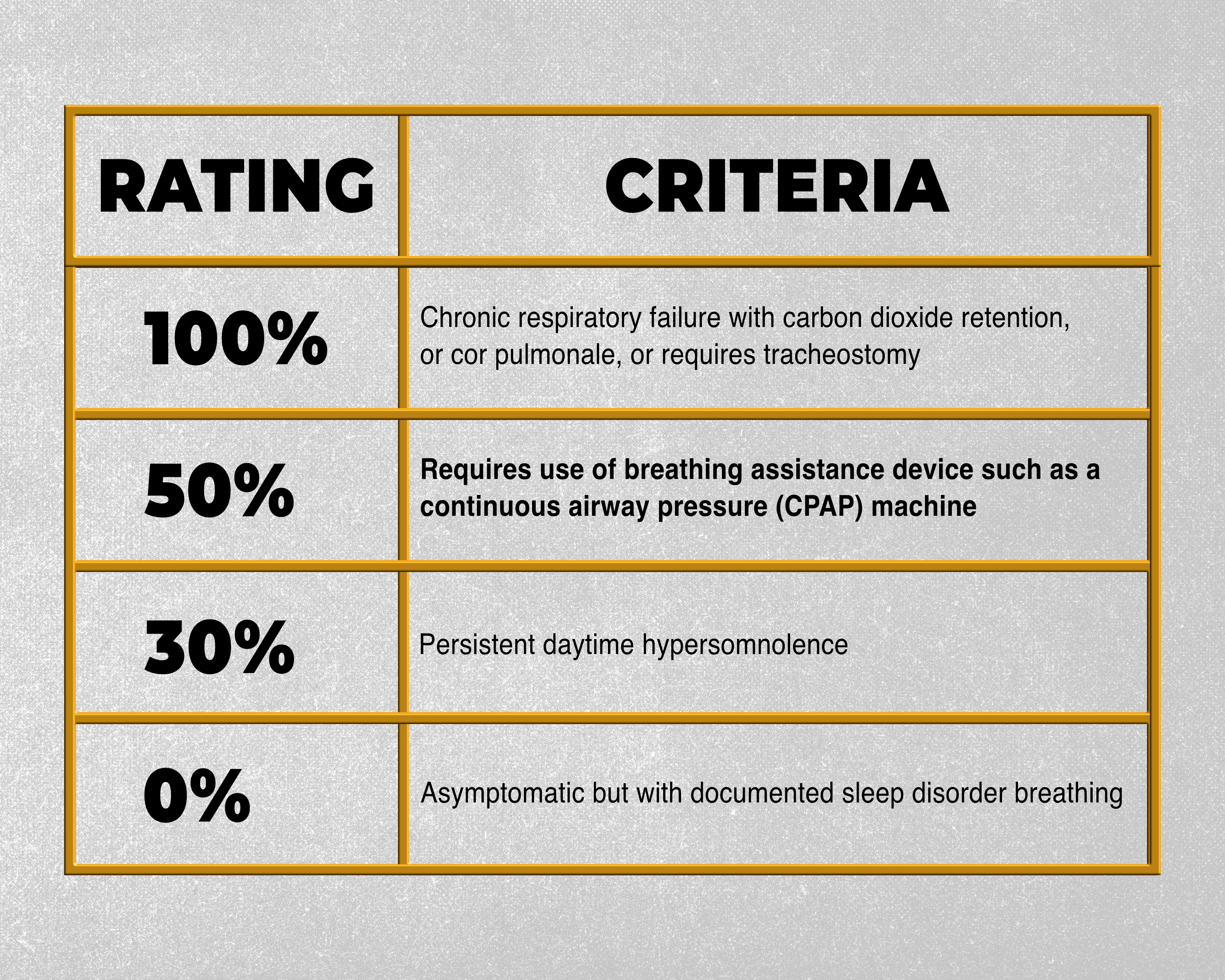
The word that matters is “requires”
The 50% criterion is written around medical requirement, not around successful use.
That distinction is the whole argument.
Many veterans cannot tolerate PAP therapy — CPAP, APAP, or BiPAP. Mask intolerance,
claustrophobia, pressure intolerance, nasal obstruction, and equipment problems are
common and clinically recognized. A veteran who was prescribed a device and struggled
to use it has not stopped requiring one; the underlying pathology that made the device
medically necessary is unchanged.
What carries this argument is documentation of medical necessity, not hours of
use. A record showing the prescription, the clinical basis for it, and continued provider
assessment that the device remains medically indicated speaks to the criterion as
written. A record showing a prescription years ago, no follow-up, and no current
indication is a weaker position — not because non-compliance disqualifies a veteran, but
because the record no longer establishes current requirement.
Veterans in this situation are well served by having the intolerance itself documented in
their medical record, along with the provider’s assessment of ongoing need, rather than
simply discontinuing use silently.
⚠️A change is proposed — and it targets exactly this
VA published a proposed rule revising the respiratory rating schedule on February 15,
2022, with a supplemental proposed rule in September 2024. The proposal would
restructure DC 6847 to rate sleep apnea by treatment effectiveness rather than by
device requirement — eliminating the automatic 50% tier for device use.
As of this writing, no final rule has been published and no effective date has been
set. Sleep apnea continues to be rated under the current DC 6847 criteria above.
Two things worth understanding about how rating changes generally operate: VA’srating-reduction rules in 38 CFR § 3.344 impose requirements before an established
evaluation can be reduced, and revisions of this kind are typically directed at claims
decided after the effective date. Veterans should verify current regulatory status at
eCFR.gov rather than relying on any secondary source — including this one — for
something this consequential.
What Actually Carries Weight in the Record
The primary’s rating decision. Element one of a secondary theory is already
established. Have it.
A current sleep study. OSA is diagnosed by study. Without one, there is no current
diagnosis to connect to anything.
A documented weight trajectory, where the obesity intermediate step is in play.
Separation weight forward.
A medical opinion that walks the actual test. For an intermediate-step theory, that
means addressing all three General Counsel elements explicitly — including the but-for
element — rather than asserting a conclusion.
Documentation of PAP necessity and, if applicable, intolerance. Prescription,
clinical basis, and current provider assessment.
Why the Credibility of a Nexus Source Matters
Veterans Creed does not write, provide, broker, or refer nexus opinions. That work
belongs to licensed clinicians who have evaluated the veteran and reviewed the records.
We do consider it part of our responsibility to make sure veterans can tell a credible
opinion from a worthless one — because this is a space where veterans spend real
money on documents that carry no weight, and nobody explains the difference until
after the denial.
A credible opinion:
Reflects an actual review of relevant medical and military records
States the standard explicitly — at least as likely as not
Explains the mechanism, not just the conclusion
Walks each element of the applicable legal test, including all three intermediate-stepquestions where obesity is the pathway
Addresses contrary evidence rather than ignoring it
Addresses aggravation separately, with baseline, if that theory is in play
Comes from a clinician whose credentials fit the conditions at issue and who is
identifiable and willing to stand behind it
Warning signs:
Template language with the condition dropped into fixed paragraphs
No record review — an opinion rendered without examining the veteran or the file
Outcome marketing — any promise of a rating, percentage, or approval
Conclusions with no mechanism
Fees structured around the claim result rather than the professional work
Pressure to purchase quickly
A well-constructed opinion from a clinician who reviewed the record and explained the
medicine is evidence. A generic document from a volume operation is a receipt.
The Timing Point
Under 38 CFR § 3.2601(f), the evidentiary record in a Higher-Level Review is limited
to the evidence of record as of the prior decision, and the higher-level adjudicator
may not consider additional evidence.
A medical opinion submitted with the claim travels into HLR, where a senior reviewer
evaluates whether it was weighed correctly. An opinion obtained after a denial cannot
be considered at HLR at all — it requires a Supplemental Claim, a different lane with
different effective-date consequences.
Evidence developed before a decision preserves both lanes. Evidence developed after a
denial closes one.
Separately, where VA failed to obtain a required examination or opinion at all, that is a
duty-to-assist error under § 3.2601(g), which the higher-level adjudicator must return
for correction. Knowing which problem a decision presents determines which lane fits.
Common Misunderstandings
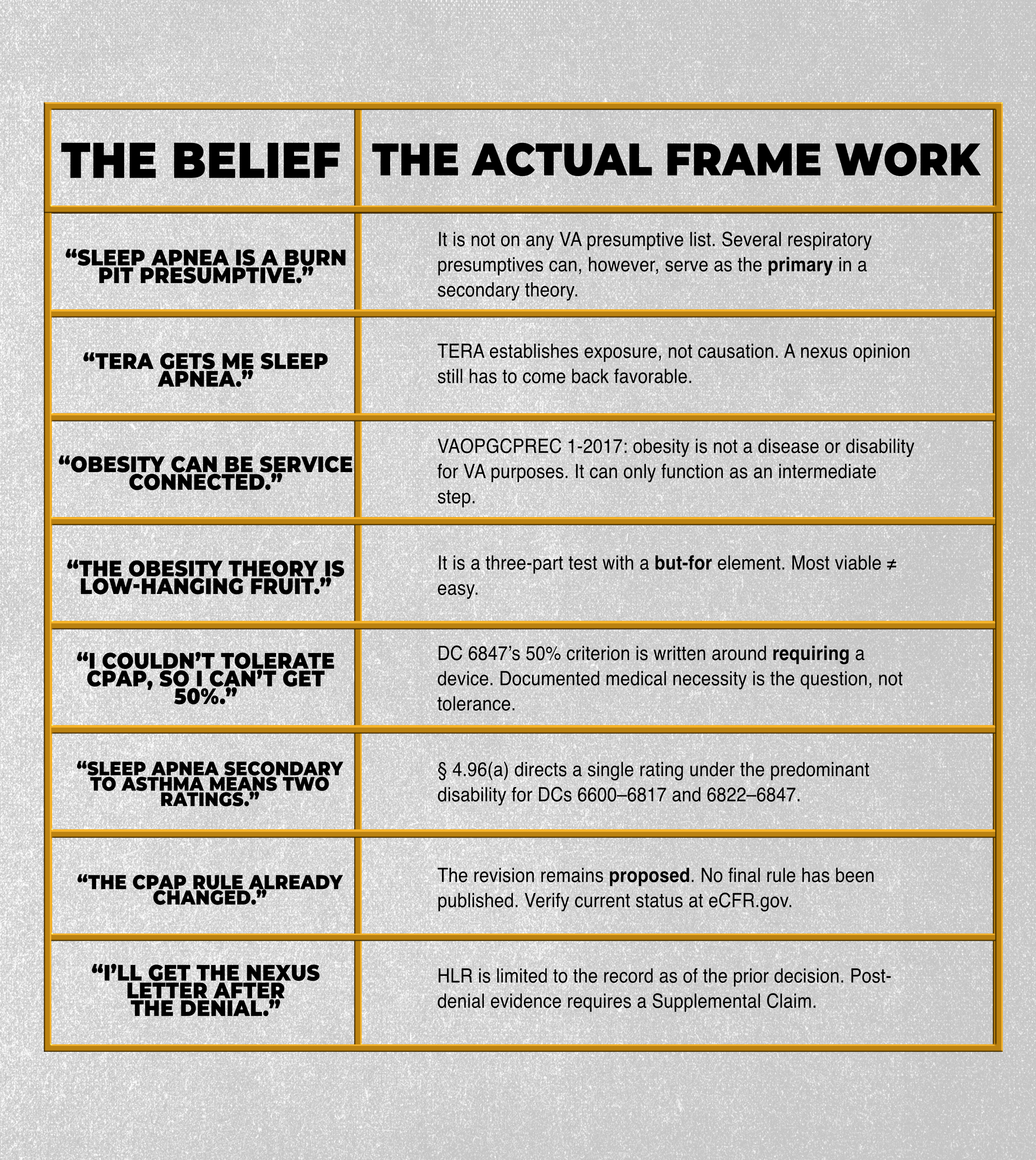
Questions Worth Sitting With
Which of my already rated conditions has a mechanism a clinician could actually explain in relation to sleep apnea — airway, sleep architecture, medication, or activity and weight?
If weight is the pathway, does my record show a weight trajectory that tracks with the progression of the primary condition?
Is my strongest theory causation or aggravation — and if aggravation, does a documented baseline exist?
Does my record contain a current sleep study?
If PAP therapy is prescribed but I can’t tolerate it, is the intolerance and continuing medical necessity documented — or did I simply stop?
If my primary is a respiratory condition, have I looked at how § 4.96(a) affects what a grant would actually be worth?
These are the right questions to bring to an accredited VSO, claims agent, or attorney, and to a treating clinician who knows the record.
A Note on Self-Representation
A veteran is not required to be represented. Under 38 CFR § 14.631(a), the power-of-attorney requirement attaches to the person representing a veteran — not to the veteran. Veterans proceed on their own behalf at every stage.
Sleep apnea secondaries are evidence-driven, and the intermediate-step framework is one of the more technically demanding structures in the system. Accredited VSO representation is free, and medical opinions come from licensed clinicians — neither of which any educational resource replaces.
Sources
VAOPGCPREC 1-2017 — Service Connection Based on Obesity — VA Office of General Counsel, January 6, 2017
Walsh v. Wilkie, 32 Vet. App. 300 (2020)
38 C.F.R. § 3.310 — Disabilities proximately due to, or aggravated by, service-connected disease or injury — eCFR
38 C.F.R. § 4.97 — Schedule of ratings, respiratory system (DC 6847) — eCFR
38 C.F.R. § 4.96 — Special provisions regarding evaluation of respiratory conditions— eCFR
38 C.F.R. § 3.2601 — Higher-level review — eCFR
38 U.S.C. § 1168 — Medical nexus examinations for toxic exposure risk activities — Office of Law Revision Counsel
VA Presumptive Service Connection Eligibility (PDF) — VA, February 4, 2026
Federal Register — Schedule for Rating Disabilities: Respiratory System, proposed rule, February 15, 2022 (supplemental proposed rule September 2024; not final)
Educational Use Only: This content is for general informational purposes and reflects how VA processes generally work. It is not legal advice, not medical advice, and does not apply to any individual’s specific situation. Medical opinions come from licensed clinicians who have evaluated the veteran. Veterans are encouraged to connect with an accredited VSO, claims agent, or attorney for guidance tailored to their circumstances.
Scope note: Veterans Creed Veteran Services provides education only. VCVS is not accredited by the Department of Veterans Affairs, is not affiliated with the VA, does not file claims, does not represent veterans before the VA, and does not provide medical opinions or nexus documentation. Regulations change — veterans should verify current information at VA.gov and eCFR.gov.