The Sound That Won’t Stop:Understanding Tinnitus and Your Mental Health
If you live with a constant ringing, buzzing, or hissing in your ears, you already know the toll it takes. But there is a side to tinnitus that often goes unaddressed: the heavy, exhausting toll it takes on your mental health.
If you find yourself feeling worn thin, short-tempered, or constantly on edge, it isn't a character flaw. It is a human response to a sound that simply won't turn off.
Perceived Sound, Real Exhaustion
Tinnitus is defined as a perceived sound with no external source. But "perceived" does not mean imaginary. The signal is entirely real to the person experiencing it.
Tuning out an relentless internal noise takes immense cognitive energy. When you never get a break from that effort—especially at night when the rest of the world goes quiet—the constant drain builds up.
The Exhaustion Loop
The Signal: The sound is constant, drawing your focus.
Sleep Loss: The noise peaks in quiet settings, making quality sleep difficult.
Emotional Strain: Chronic sleep loss leads to irritability, anxiety, and low mood.
Heightened Sensitivity: Exhaustion makes your nervous system more reactive, making the tinnitus feel even louder.
Research backs this up: a 2019 systematic review of 28 studies found a 33% median depression prevalence among tinnitus patients. Further research links tinnitus directly with elevated rates of anxiety, stress, and severe insomnia.
The Legal Framework: Secondary Connection
For veterans, tinnitus is one of the most common service-connected conditions. Under 38 CFR 3.310, a mental health condition can be claimed as secondary to an already service-connected condition like tinnitus.
Establish secondary service connection requires three key elements:
A Current Diagnosis: A formal mental health diagnosis by a qualified medical professional.
A Primary Service Connection: An established, direct service connection for tinnitus.
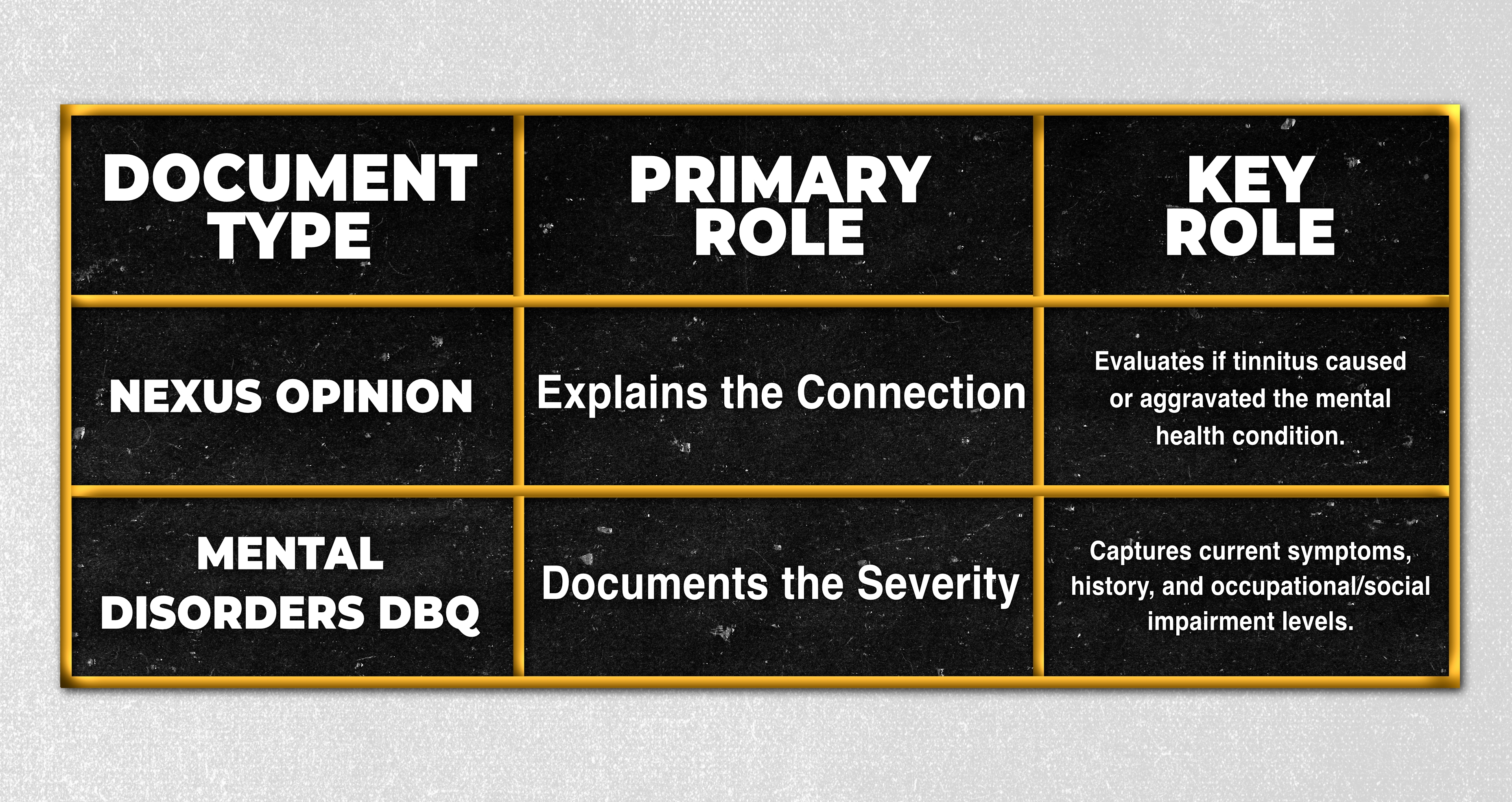
A Medical Link (Nexus): Competent medical evidence demonstrating that tinnitus either caused the mental health condition or aggravated (worsened) an existing one.
Key Takeaway: A secondary connection is never automatic. Simply having service-connected tinnitus does not automatically establish a mental health claim; the clinical evidence must clearly connect the dots.
Diagnoses vs. Impairment: What Matters Most
Veterans often worry about getting the exact right label—whether it’s Major Depressive Disorder, Generalized Anxiety Disorder, or Adjustment Disorder.
However, under the General Rating Formula for Mental Disorders (38 CFR 4.130), the diagnosis gets you through the door, but occupational and social impairment determines the rating level. The central question is: How severely does this condition impact your work and your daily relationships?
Building Strong Medical Evidence
When documenting your condition for medical evaluations, focus on accuracy, consistency, and detail:
Be Concrete: Vague statements like "I get anxious" carry less weight than specific examples, such as "I have to leave family gatherings after 20 minutes because the room noise drives up my anxiety".
Document Bad Days: Detail how symptoms degrade your sleep, focus, home life, work performance, and social connections over time—rather than offering a single snapshot of the day you're examined.
Provide Full Medical History: Never hide prior struggles, such as childhood trauma or pre-service events. Strong medical evidence acknowledges and explains inconvenient history; hiding it risks damaging your overall credibility.
Avoid Promises and Templates: Beware of providers guaranteeing specific rating outcomes. A credible medical opinion requires a comprehensive record review and individualized clinical reasoning.
Educational Note: This content is for informational purposes only and does not constitute legal or medical advice. Claims requirements vary based on individual facts. For assistance with specific claims, consult an accredited Veteran Service Officer (VSO), claims agent, or attorney.